
Melt-up summer
financial markets join a cult, EU age verification app is good, actually; plus! coffeezilla, and some links.
Hello children, I have new content for you. Some of it might make you mad, some of it is almost certainly factually incorrect. What matters is that we are here, being mad and wrong together. If you need to contact me for any reason (and I mean any reason), you can find me on Mastodon.
Here's what we have today :
- Everything is hodl now
- Fraud and gambling, forever and ever
- EU age verification: good, actually
- Take some time to be human
- Strays
Let's hop into it!
Everything is hodl now
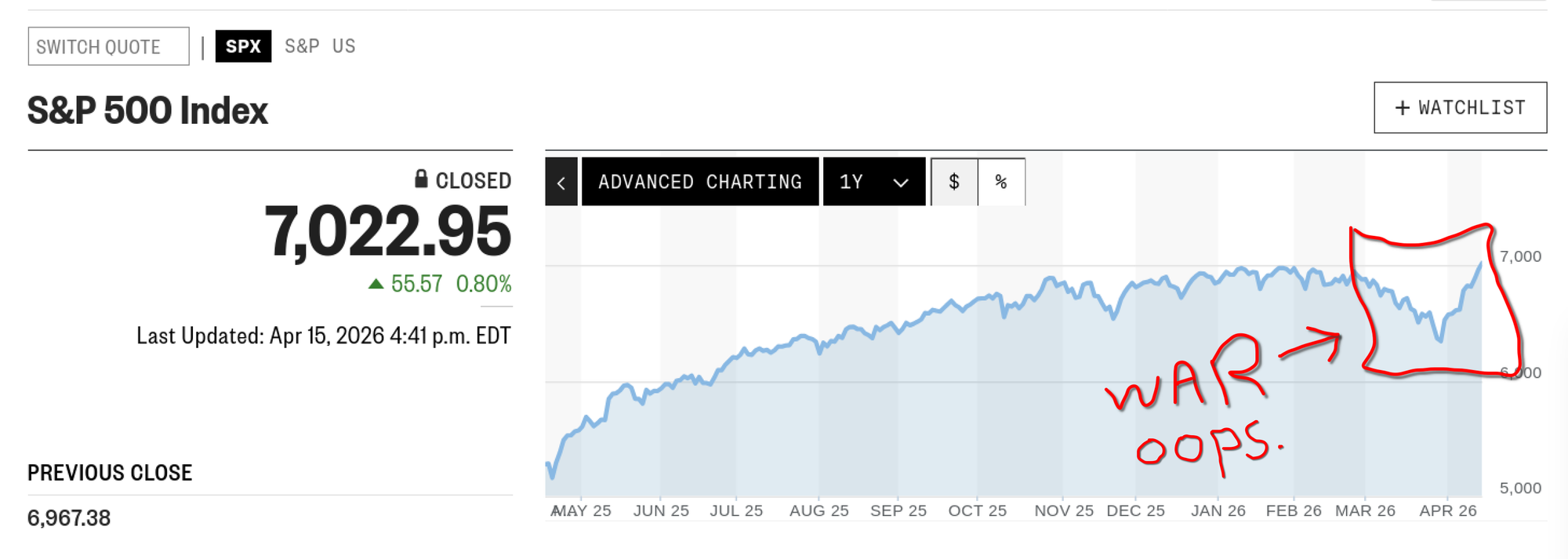
As the S&P makes record highs, somehow, I have a wild theory about what's happening to the stock market, which I shall call "GameStopification." Basically, the broader "Financial Community" (ie - a thousand guys living in Connecticut and Long Island who are baking their brains on X) has acquiesced to the idea that fundamentals don't matter. The only thing that matters in asset pricing is sentiment, and if everyone decides to feel positively about the market at the same time, line go up!
Of course, this has always been true with financial markets. Animal spirits and all that. But something started to break in the early 21st century with the emergence of the tech startup and the problem of how to price one. Definitionally, a tech startup is valued based on the unknowable future, therefore the value is speculative, therefore the traditional ways of measuring value like price-to-earnings are meaningless. If you used traditional financial analytical methods to estimate the value of Google and Facebook right after they IPO'd, you missed out on getting rich.
The smart way to value a tech startup is not metrics, it's feelings. Who has the best story? Which founder has the most compelling personality? So the question of how to price a stock was already in flux.
Then the COVID-19 pandemic happened and turned everyone's brains to warm oatmeal.
OK, to be more precise, a whole slew of economic, political, cultural, pop-cultural, and epidemiological factors meant that a lot of people with extra money were isolated at home with access to algorithmic social media and digital trading platforms.
It was around this time that we got the whole GameStop saga. In case you are not familiar, they made a movie about it that's pretty fun. In a nutshell, a bunch of redditors on the /r/wallstreetbets subreddit became convinced that some big investment funds shorting the struggling video game retailer were overexposed, and decided that if they all bought and "hodl"ed the shares at the same time, they could do a short squeeze.
It worked:
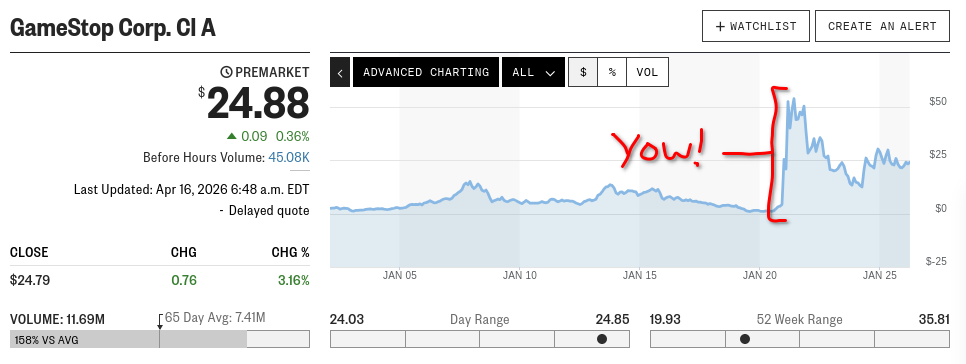
The thing to remember here is that GameStop was essentially worthless. The brick-and-mortar retail sector had collapsed and it was heading for bankruptcy-- everyone could see that from the fundamentals-- and the short-sellers were set to profit from it.
But what the redditors did wasn't really just a brilliant technical gambit. Yes, some of them can read and do math, but for most of them, it was a vibe, a community, a movement, practically a religion: "diamond hands" the mantra, a fierce belief in "line go up" the dogma.
The GameStop saga is emblematic of a kind of social media-inflected cult-like devotion to specific financial assets that emerged everywhere during the pandemic, as people extended the anti-logic of tech stock valuations to other assets. Bitcoin went vertical, Dogecoin was up by like 1,000%. Tesla went crazy:
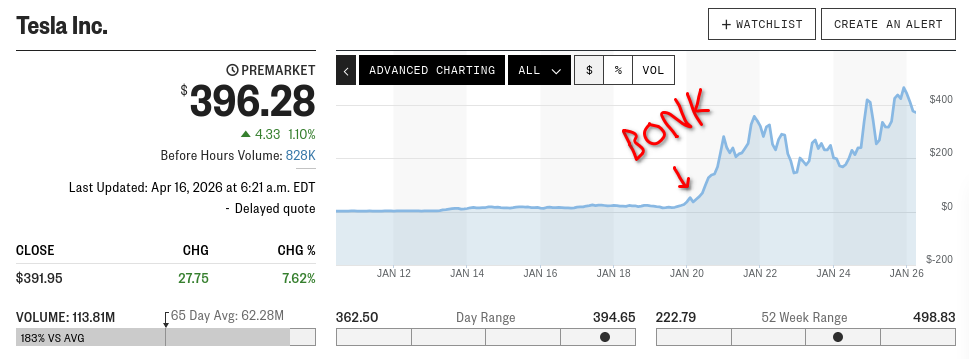
And it was all basically for no reason. It was the power of positive thinking, the Church of Line Go Up, everyone believing they could get rich by believing they could get rich. And it fucking worked. Cooler heads tried to prevail, they tried to show the Tesla valuation made no sense, that Bitcoin would inevitably crash, that everyone was smoking hopium, and for the most part, those people lost their shirts. They were right on the fundamentals, but it did not matter.
And that's where we are today, with AI, trade tariffs, oil, the Iran War, all of it. The fundamentals don't matter. The S&P 500 is making new highs, the NASDAQ is effervescent, the round-and-round AI financing circle-jerk continues, the Church of Line Go Up has won because now everyone believes, they are rolling in the aisles, barking like dogs, they are taking up deadly serpents and they are not harmed, for Moody's has rated them investment grade.
The bears have been slain. We worship a golden bull, forever and ever, amen. It is the age of melt-up. It is the times of euphoria.
Fraud and gambling, forever and ever
I like coffeezilla's latest little hit. We live in the stupidest of times, just try to enjoy it as much as you can.
EU age verification: good, actually

The EU has announced that its app for user age verification is ready to be rolled out, and honestly, it sounds like a pretty good plan! Wait wait, before you throw a battery at my head, hear me out.
Digital age verification entails two main problems: a technical one, and a political one. First, let's look at the technical one.
The technical objection to age verification is that, on the internet, verifying someone's age could entail a massive violation of everyone's privacy:
- How do you verify age without exposing identity?
- How do you avoid keeping records of sensitive information like the pornography someone consumes, or the comments they make on forums?
- If that information is kept somewhere, how do you keep bad actors from breaking into those systems and stealing it?
And of course, all of these technical concerns compound exponentially if you leave age verification up to private actors all rolling their own solutions.
My understanding of the EU's app is that it solves these problems. I still need to read all the documentation, and I'd love to hear the perspective of people with real software engineering experience, but for now, I'm cautiously optimistic.
The EU's solution is an app provided by the government that you put on your phone (or you could connect to it from a browser) where the user's ID is verified using a national ID or a passport, just like with other digital public services that European countries already provide. Then when the user tries to sign in to a private, third-party app that requires age verification (Instagram, TikTok, PornHub, etc.), that app can ping the EU age ID app, which returns the user's verified date of birth. That's it. No name, no user data, nothing. Just a date.
In terms of the technical risk this poses of inadvertently exposing a user's identification or other private data to companies or malicious actors, I don't see how it's any more of a threat than existing public service apps for banking, paying taxes, or engaging other public services that require ID verification.
The EU's app is also supposedly open source and modular. EU members can use it as-is, or they can adapt it to their specific needs. At least on paper, it sounds like a reasonable solution to the technical problem.
Which brings us to the other problem, the political one.
The political problem is: What will governments do with the authority to mandate age verification? What if they do something bad? I would argue that this is actually irrelevant.
Outside of some weird libertarian circles, basically everyone agrees that EU governments have the authority (and, in fact, the duty!) to impose and enforce public safety regulations, and we already have age limits on things like buying alcohol, visiting sex clubs, consuming tobacco, driving cars, and accessing pornography. Applying age limits to aspects of life on the internet has always been a technical problem, but with the technical problem solved, why not do so?
It is absolutely true that states can be oppressive with respect to things like LGBTQ+ rights, reproductive rights, sex work, etc. But that's always been the case. This isn't a novel problem, and we can deal with it in EU countries the same way we've always dealt with it: applying human rights frameworks and constitutional protections, building civil society, amending laws, and raising awareness. This is just life in a pluralistic, liberal, social democracy.
Big picture, I think it is unequivocally a good thing that western democracies are starting to regulate what happens on the internet. For too long, we've let the early 2000s techno-libertarian US-centric "freeze peach" approach dominate how democracies think about internet regulation, and it hasn't worked. In fact, it's been a disaster.
I don't think age verification is the best way to regulate things like social media. Personally, I would like to see some CEOs imprisoned. But it's a start.
Take some time to be human
Do what Jonny says. Put your agentic workflows down. Step back from your pipelines. Close that chat, let quantum physics figure itself out.
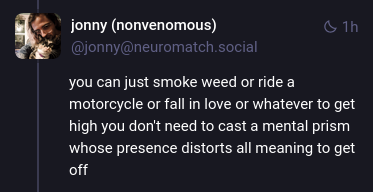
The LLMs aren't real, they are a billion lines of matrix multiplication in a trench coat, forget about it. Make yourself a grilled cheese sandwich and sit outside while you eat it and think about nothing. Pet a dog. Take a long, hot bath. Walk for miles, in no particular directly.
Strays
- Anthropic is jacking up its prices for power users of its Claude models.
- This person on GitHub speculates that Anthropic is "constructively terminating" its subscription plans to focus on enterprise clients.
- PREVIOUSLY FROM ME: Claude is a mess.
- Maine's legislature passed a bill that would make it the first state to put a blanket moratorium on data center construction. The governor might veto it though.