
Rise of the NIMBAIs
when layoffs don't pop your stock, it doesn't matter why people hate data centers, a great podcast on chatbots, and the real AI bailout that's coming
It's like NIMBYs, but for AI? I don't know.
Anyway, hello! And welcome to this edition of the newsletter! Better than the last one, not as good as the next one. One thing I would like to highlight this week is that I have turned on comments for subscribers! Yes that's right, you no longer have to yell at me on Mastodon, you can yell at me right on the website, underneath each edition. However, you can only yell at me if you subscribe to the newsletter (for free) and sign in, so yes, it is kind of a trap.

You kinda want to tho, right??
Here's what we got this week:
- The nerds aren't buying it
- It doesn't matter why people hate data centers
- Behind the Bastards: Chatbots
- The real AI bailout
- Links
The nerds aren't buying it
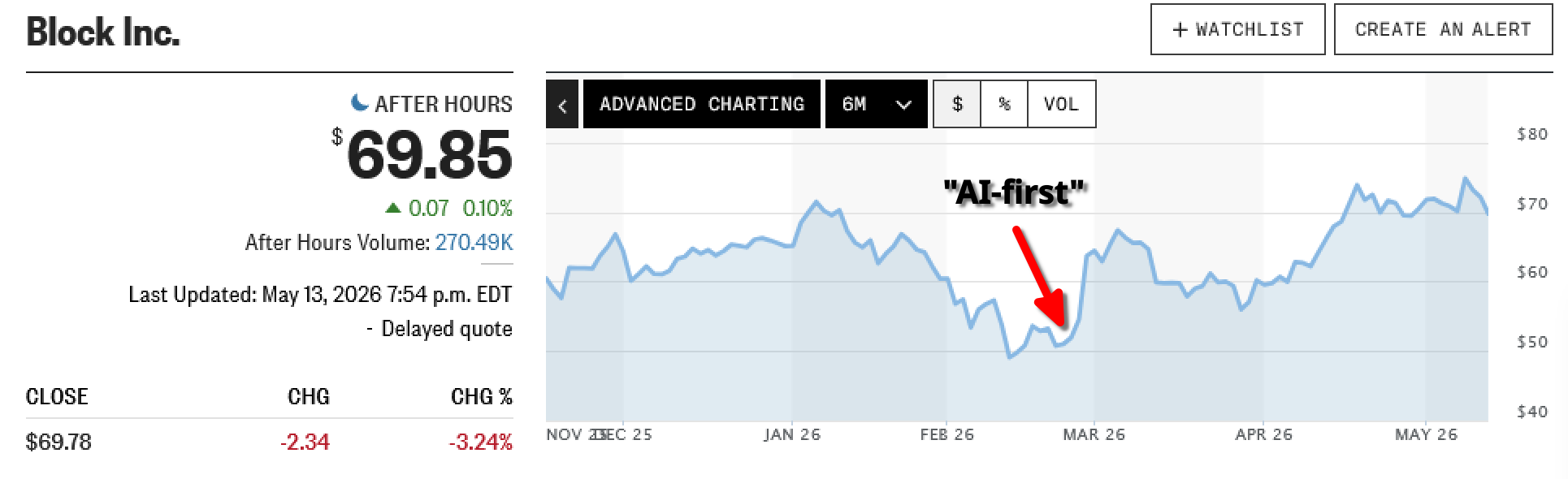
Trying to figure out the logic of asset price moves is a fool's errand, but I'm sort of a fool, so let's try it. Question: Why do some stocks pop when the CEO announces layoffs, while others sell off hard? Block announces AI-related layoffs. The stock pops:
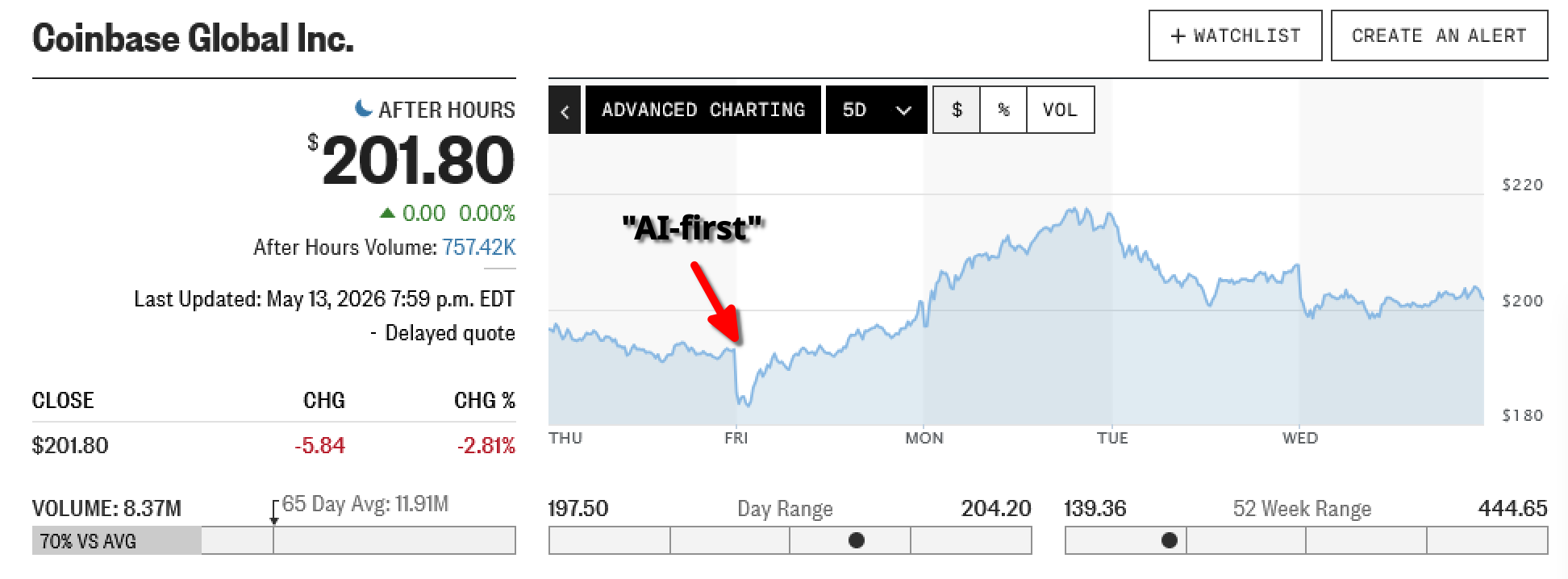
Coinbase announces AI-related layoffs. Pretty good bump:
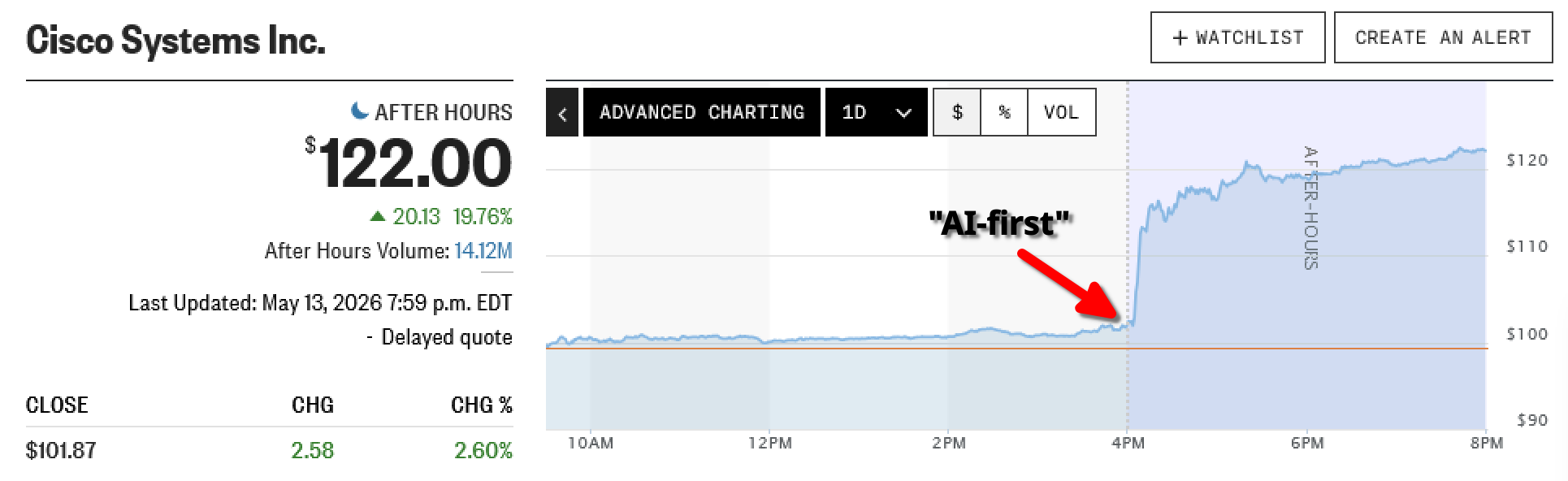
And now Cisco announces AI-related layoffs. As of this writing, the stock is up almost 20% in pre-market trading! Wow!
But look what happened to CloudFlare when it announced AI-related layoffs:
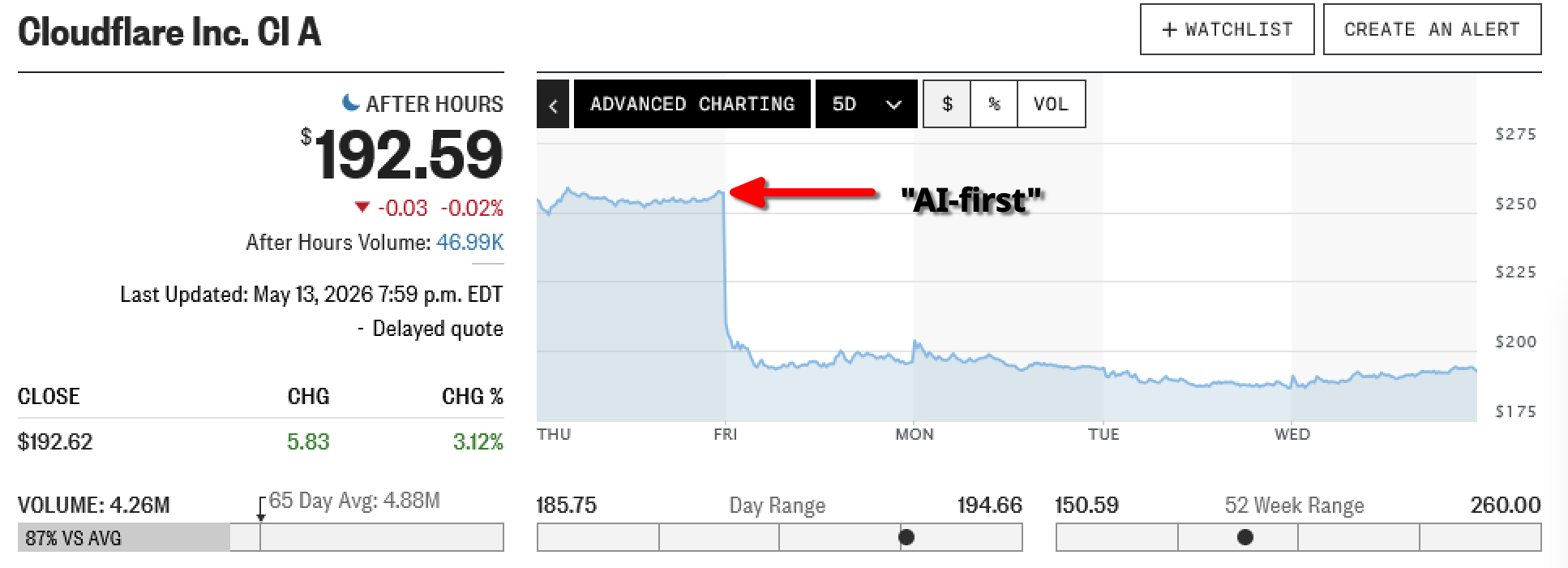
Ouch! What the fuck! And also, GitLab (which is somehow publicly traded??):
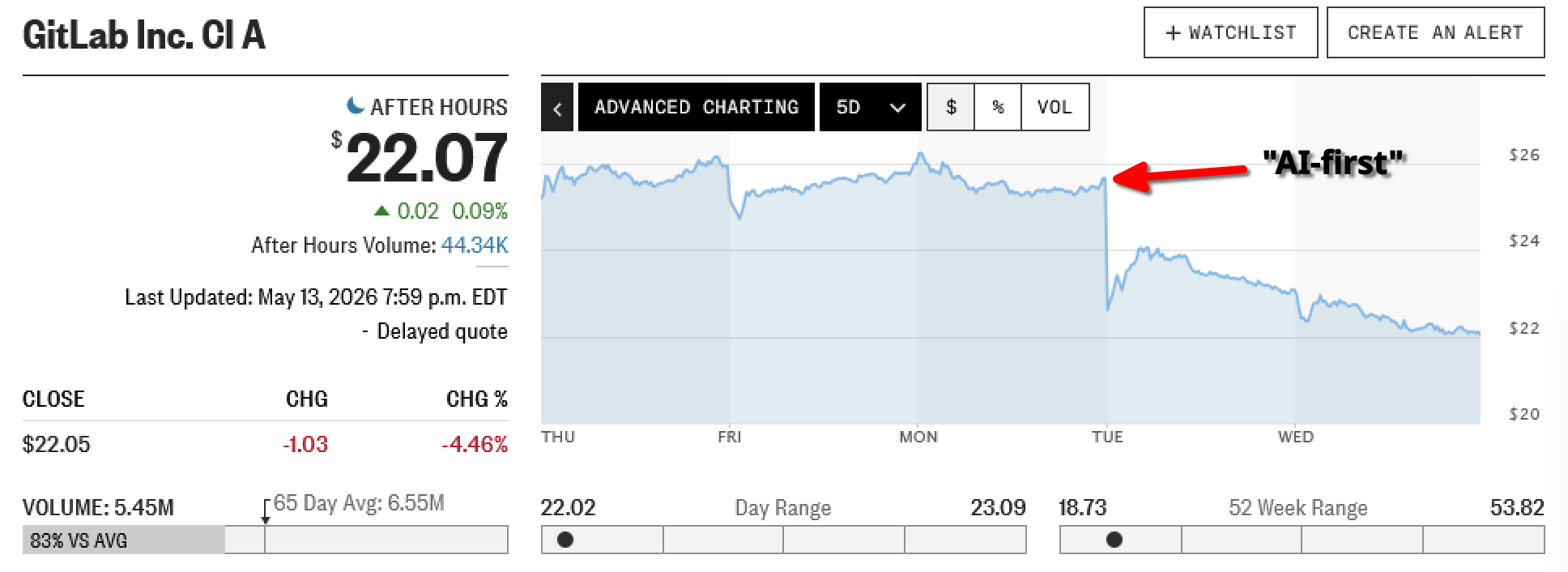
Yikes! Ow!
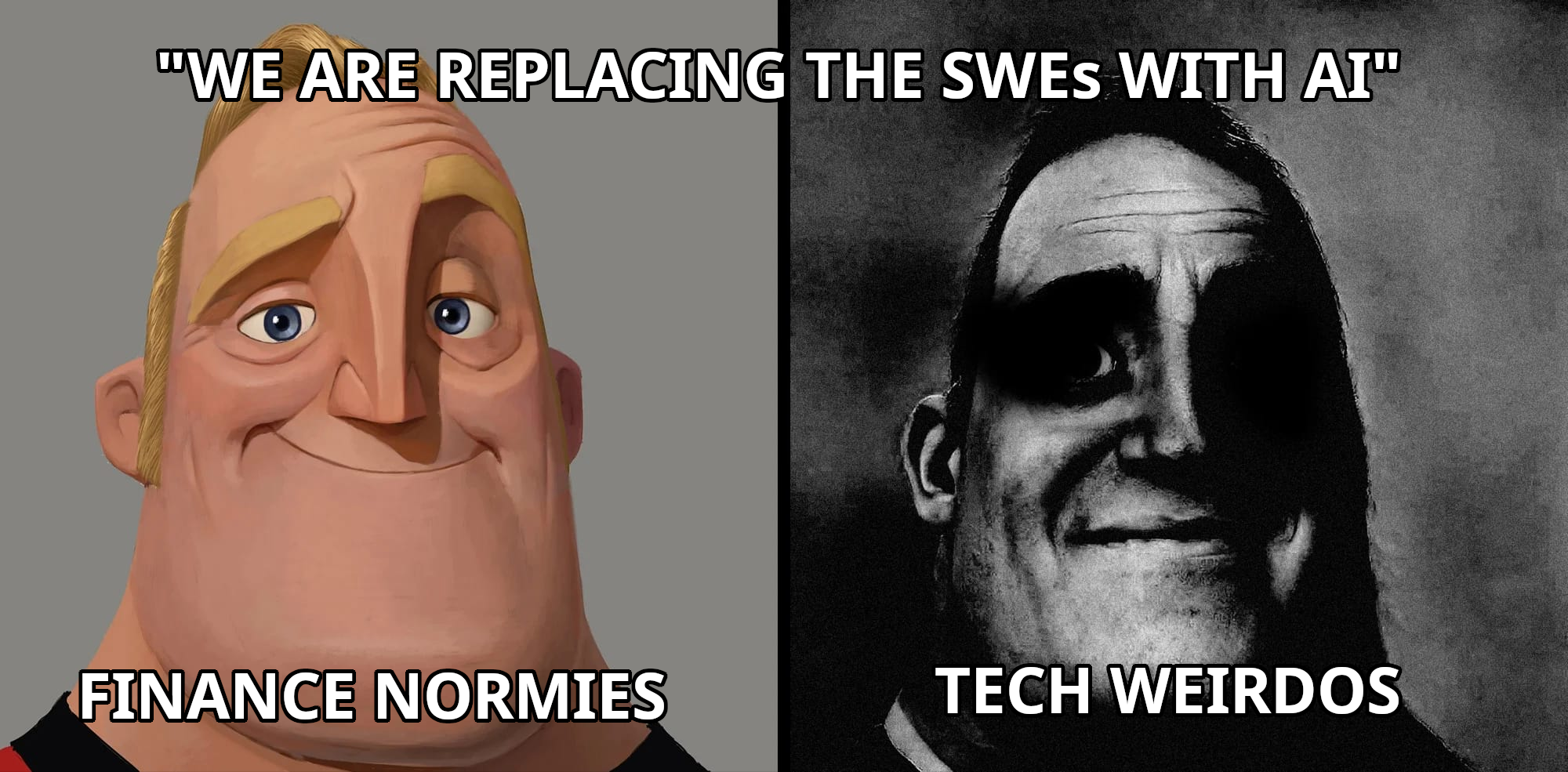
Again, there are tons of factors at play here. I am only speculating. But my speculation is that the finance normies who invest in stocks like Oracle, Block, and Coinbase are getting their analysis from other finance normies, who are all telling them that AI can definitely replace the expensive nerds who do software. For them, firing the nerds is a huge "buy" signal. Hell yeah. Get them nerds.
However, if you invest in companies like Cloudflare and GitLab, you probably understand what they do, which also makes you the kind of person who is likely to understand how LLMs work and what it means when a CEO says, "Great news! We are going to replace 20% of our software engineers with an LLM in a while True loop!"
If that means anything to you, you smash that "sell" button. Hard.
It doesn't matter why people hate data centers
People are furious at data centers. But should we worry about why they are furious at data centers? What if their fury is wrong, or misguided? Should we care? In the last couple weeks over on Bluesky, a lot of "well, actually" guys (a combination of AI dudes and urbanist YIMBYs) have been lecturing people about what they are allowed to be angry about. For example:
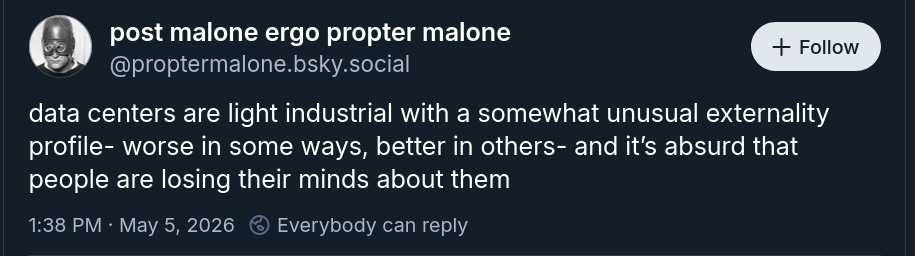
In a vacuum of context, sure. A data center is not much different from any of the other warehousey things that giant companies like Amazon, Meta, Walmart, and 3M have been building all over the country.
In a vacuum of context, data centers can pay for the electricity they use, like any other customer, and the concerns about things like water usage and heat islands are considerably overblown.
In a vacuum of context, the job situation will pencil out slightly in the black, with every data center bringing net-positive employment.
In a vacuum of context, one could expect that the rich businesses making promises to the public about the kind of hiring they will do, the kind of impact the project will have on the environment, the kind of stress it will place on local infrastructure, and the kind of timeline the project can be expected to follow will hold up their end of the bargain they are striking with the local government in exchange for tax breaks.
In a vacuum of context.
However, we have lots of context. All we have is context. We are drowning in fucking context. We have decades of late-capitalist, tech-bro context for what happens when some slick, splashy guys show up to a county board meeting and promise to spin the corn into gold.
They lie. They lie about everything. They lie about how many jobs they're going to create, they lie about how much tax revenue the local authorities are going to reap, they lie about the environmental impact of the thing they are building, they lie about the construction impact, they lie about the economic viability of the enterprise itself.
This isn't really a "tech" issue either. It's just how these large business development deals work in late capitalism: Socialize the risk, privatize the profits. Get a bunch of tax breaks and free infrastructure, fuck over the public. Get away with it.
And on top of that, we can add the ways that American tech companies, specifically, have harmed the public with impunity over the last 20 years by concentrating wealth, hollowing out local retail, wrecking the independent news media, partnering with fascism, and turning the internet into a panopticon.
All that to say, people are mad at data centers because they don't trust them. This isn't because of some elaborate TikTok psyop or lack of education, it's because you'd have to be a fucking idiot to trust Silicon Valley at this point.
And whose fault is that?
So no, I don't really care about the details of why anyone is opposing a data center. These companies have lost their benefit-of-the-doubt privileges. The AI weirdos are literally telling everyone they are building a doomsday machine. It makes perfect sense that people are opposed to that.
Behind the Bastards: Chatbots
The Behind the Bastards podcast did a two-parter on AI chatbots and of course, it is very good. If you are not familiar, every week, this podcast releases a deeply-researched episode on some terrible person—usually a historical figure, but sometimes not. Occasionally, they will do a concept or institution, and so, AI chatbots. I'm linking the YouTube videos here in case you're one of those weird people who likes to watch podcasts (🙄) but you can also just listen to it like a normal person through any of the standard podcast channels.
The upshot, which I think makes sense, is that 1) companies have built their chatbots (or trained their models) to maximize engagement, and because of that, 2) the chatbots end up using the same techniques as cult leaders, producing something like a decentralized cult. In the process, some users end up having manic episodes that can end tragically.
It's excellent, you should listen to it.
The thing I would add is this: Humans excel at pattern recognition, going back probably millions of years in our evolution, and so we are always looking for patterns. A side-effect of this is we occasionally become obsessed with finding a pattern where there is none, and it can send us spiraling. I don't think this is necessarily a bad thing.
Part of the richness of human diversity is how we have always taken these people and incorporated them into the fabric of shared human culture. Those who dedicate their lives to finding hidden or obscure meanings in religious, academic, or artistic texts enrich us all. The exercise itself holds value, by inviting us to contemplate deeply.
Now, however, large language models offer an infinitely-large esoteric text. Just like the Quran or the Torah or the Book of Romans or the lectures of Jacques Lacan, it sends certain people spiraling, but infinitely spiraling, into a pointless mania that has no social context and no external connection to the rest of us.
It's yet another example of how Silicon Valley tech companies are spilling their products into the world with little regard for how they might hurt people at scale: not knowing, not caring, using their wealth to run ad hoc psychological and sociological experiments on billions of people for profit. Like the chemical manufacturers of the 20th century, but instead of our bodies, they are harming our minds.
The real AI bailout
Doomers online love to shitpost about how when the AI bubble bursts, the AI companies will just get bailed out by the government, a repeat of the 2008 financial crisis. I don't think this makes any sense for all kinds of political and practical reasons, the main one being that the global economy requires a functioning banking system, whereas it does not require robot e-mail butlers.
However, that's not to say the AI companies will not seek a government bailout, and in fact they are seeking one now, in the form of government contracts. If they can make AI as ubiquitous as a public service, like electricity, they can lock up the most deep-pocketed clients in the world: states.
Thus, OpenAI has announced a "partnership" with Malta to "roll out ChatGPT Plus to all Maltese citizens":
At OpenAI, we’re turning intelligence into a global utility. We believe that, like electricity, intelligence should be available for people, businesses, and institutions to use as much as they need, where and when they need it. That vision only matters if people can actually use these tools in ways that improve their own lives and communities. (emphasis mine)
The details don't matter that much. I just want to highlight that as consumers lose interest in AI and the dream of becoming the next iPhone fades, watch for these companies to look to the public sector for the revenue they desperately need to keep the ball in the air.
Links
- Gallup can't get real people to answer the phone anymore so they are looking at using AI to produce "simulated" responses. Surely this will be fine.
- Another commencement speaker got booed over AI comments. This time, it was Google co-founder* Eric Schmidt. (previous incident)
- Seth Rogan says if you are using AI to write, "you shouldn't be a writer" 💪
- More polling finds that AI is making everyone feel bad about the future.
- People are starting to realize that edtech sucks. That massive Canvas data breach that affected more than 8,000 schools and left students locked out of tests and grades during finals season probably did not help.
- "Everyone is horny and angry and not believing anything they are seeing."
\* Eric Schmidt isn't a Google cofounder, Larry Page and Sergey Brin brought him on in 2001 as CEO. I made this mistake all by myself!